
Can Your Business Recover When the Worst Happens?
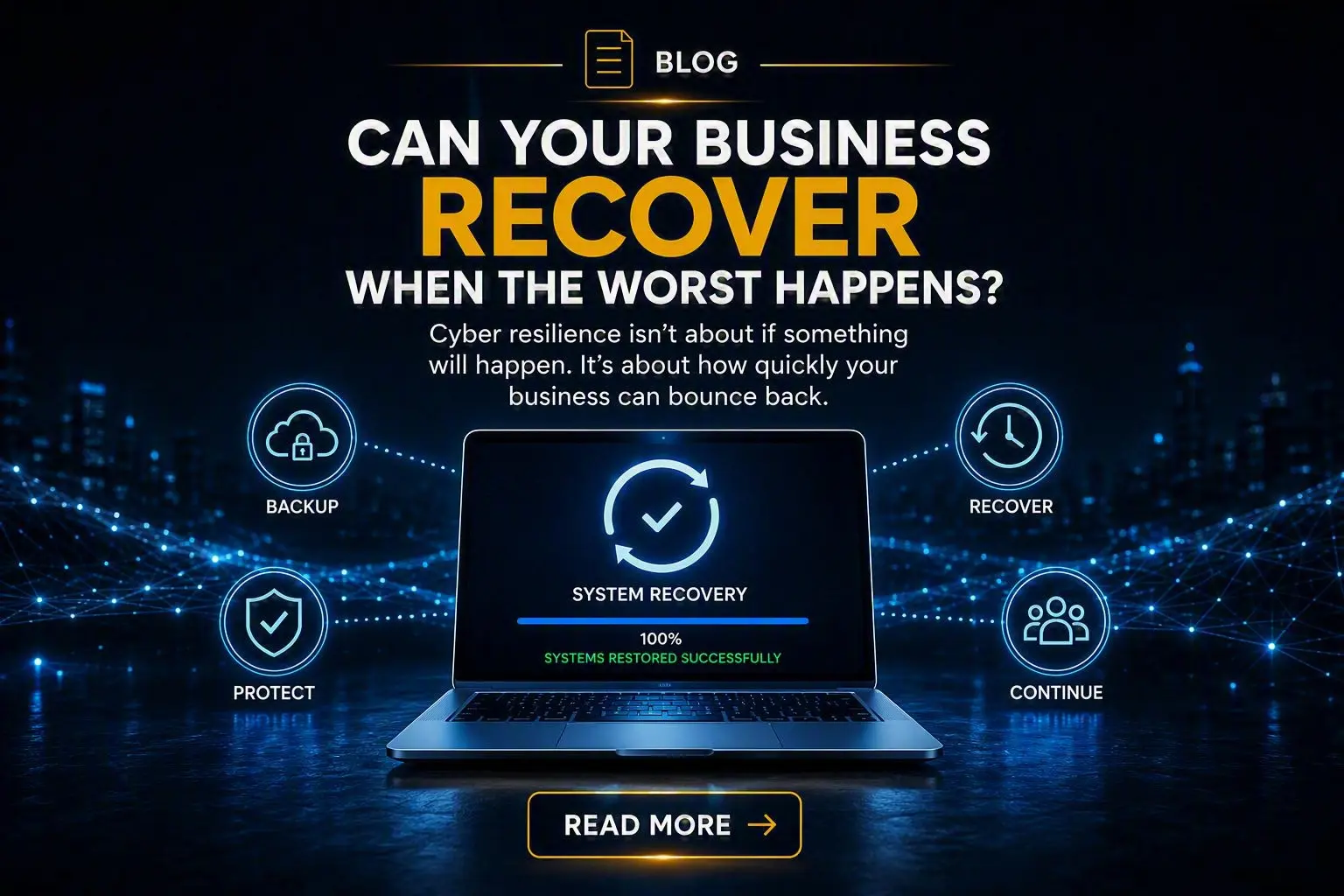
Cybersecurity is often discussed in terms of prevention. Businesses invest in firewalls, endpoint protection, multi-factor authentication, email security and employee awareness training to reduce the likelihood of a successful attack. These measures are essential, but even the strongest security strategy cannot guarantee that a business will never experience a cyber incident.
The more important question is what happens when something goes wrong.
A ransomware attack, hardware failure, major outage, compromised account or serious data loss can bring normal operations to a standstill. For a business that depends on technology for communication, finance, customer service and day-to-day operations, even a short period of downtime can have significant consequences.
Cyber resilience is about preparing for that possibility and ensuring the business can recover.
Prevention Is Only Half the Strategy
No organisation can eliminate every risk. Businesses can reduce their exposure considerably, but there will always be new threats, human error, technical failures and unexpected events to consider.
This is why cybersecurity should not stop at prevention.
A resilient business assumes that something could eventually go wrong and prepares accordingly. That means having reliable backups, clear recovery procedures, appropriate security controls and a plan for maintaining critical operations during an incident.
The objective is not simply to prevent an attack. It is to ensure that one incident does not become a prolonged business disruption.
How Quickly Could Your Business Recover?
Imagine arriving at work on Monday morning to discover that your systems are unavailable. Employees cannot access Microsoft 365, files are inaccessible, key applications are offline and critical business data cannot be reached.
How long would it take to get the business operating again?
For many organisations, the answer is not immediately obvious.
Having backups is important, but backups alone do not constitute a complete recovery strategy. Businesses need to understand what is being backed up, how frequently backups are taken, where they are stored and, most importantly, whether the data can actually be restored when required.
Recovery also needs to consider the systems and services that employees rely on every day. Restoring a file is very different from restoring an entire working environment.
Backups Need to Be Part of a Recovery Strategy
A backup is only valuable if it can be recovered successfully.
Businesses should regularly review their backup strategy to ensure critical data is protected and that recovery processes are tested. This includes understanding how quickly systems can be restored and what information would be prioritised if multiple systems were affected.
It is also important to consider the security of the backups themselves. If an attacker gains access to a business environment, they may attempt to compromise or delete backups to make recovery more difficult.
A resilient backup strategy therefore needs to consider security, availability, retention and recovery, rather than simply whether a backup job completed successfully.
What Happens If Microsoft 365 Is Compromised?
Cloud services have transformed the way businesses work, but moving data and applications to the cloud does not remove the need for resilience planning.
Microsoft 365 accounts contain valuable business information, including emails, documents, contacts and calendars. If an account is compromised, data can potentially be accessed, manipulated or deleted.
Businesses should therefore consider how their Microsoft 365 environment is protected and what recovery options are available if information is accidentally deleted, maliciously removed or compromised.
The assumption that cloud automatically means backed up and recoverable can create a dangerous gap in a business’s resilience strategy.
Your Recovery Plan Needs to Be Practical
A recovery plan should not exist simply as a document sitting in a folder that nobody opens until an emergency occurs.
It needs to be practical, understood and regularly reviewed.
Businesses should identify their most critical systems and establish which services need to be restored first. They should also identify who is responsible for making decisions during an incident and how employees, customers and other stakeholders would be kept informed.
The plan should account for different scenarios because recovering from a hardware failure is not necessarily the same as recovering from ransomware or a compromised account.
The more realistic the planning, the more useful it becomes when the pressure is on.
Test Your Recovery Before You Need It
One of the biggest weaknesses in business continuity planning is assuming that everything will work when it is needed.
Recovery processes should be tested.
Testing can identify problems that may otherwise remain hidden, such as missing credentials, incomplete backups, unsupported systems or unclear responsibilities. It also gives employees an opportunity to understand what they would actually need to do during an incident.
A recovery plan that has been tested is far more valuable than one that simply looks good on paper.
Resilience Protects More Than Your Data
The impact of a cyberattack or major IT failure goes beyond lost files.
Employees may be unable to work. Customers may be unable to access services. Payments could be delayed. Communication could stop. Deadlines may be missed and confidence in the business could be affected.
For this reason, cyber resilience should be considered a business issue rather than simply an IT issue.
The ability to recover quickly can protect revenue, customer relationships, employee productivity and the reputation of the organisation.
Ask Yourself These Questions
Every business should be able to answer a few fundamental questions about its resilience strategy.
What would happen if our primary systems became unavailable tomorrow? How quickly could we restore our critical services? Are our backups protected from the same threats as our live environment? Have we tested our recovery processes recently? Who would take responsibility during a major incident? And could our employees continue operating while systems are being restored?
If the answers are unclear, there may be a gap between being protected and being genuinely resilient.
Building a Business That Can Bounce Back
Cybersecurity is not about creating an environment where nothing can ever go wrong. It is about reducing risk, preparing for disruption and ensuring the business has the ability to respond when something does happen.
Strong security controls help prevent incidents. Employee awareness helps reduce human risk. Reliable backups protect critical information. Tested recovery plans help restore operations.
Together, these measures create something much more valuable than protection alone. They create resilience.
At VBT, we help businesses look beyond individual security products and develop a more complete approach to IT resilience. From backup and disaster recovery to cybersecurity and ongoing IT management, our focus is on helping organisations remain secure, operational and prepared for whatever comes next.
Other News
Your Employees Are Your First Line of Defence. Or Your Biggest Risk.
Cybersecurity is often viewed as a technology challenge. Businesses invest in firewalls, antivirus software, endpoint protection, and secure networks to keep threats at bay.…
Your Employees Are Already Using AI. The Question Is: Are You Managing the Risk?
Artificial intelligence has moved from being a future technology to an everyday business tool almost overnight. Employees are using AI to draft emails, analyse…
Can Your Business Recover When the Worst Happens?
Cybersecurity is often discussed in terms of prevention. Businesses invest in firewalls, endpoint protection, multi-factor authentication, email security and employee awareness training to reduce…
Your Employees Are Your Strongest Defence. Or Your Biggest Risk.
Cybersecurity is often associated with firewalls, antivirus software, secure backups, multi-factor authentication and increasingly sophisticated security platforms. These technologies are essential, but they are…
The Productivity Gap: Is Your Technology Helping or Hindering Your Team?
Every business wants a more productive workforce. Organisations invest heavily in recruiting talented people, developing their skills and creating environments where they can do…

Why Your IT Should Be Driving Growth, Not Just Keeping the Lights On
For many organisations, technology has traditionally been viewed as a support function. Its primary purpose has been to keep systems running, resolve technical issues…
Future-Proofing Your IT Strategy: 5 Questions Every Business Leader Should Ask
Technology has become one of the most important drivers of business success. It influences how organisations communicate, serve customers, manage operations, protect data, and…

Could Your Business Operate Tomorrow Without Its Key People?
Every organisation has them. The people who seem to know everything. They understand the systems, processes, customer relationships, supplier contacts, and day-to-day operations that…
The Cost of Waiting: Why Businesses Delay Technology Decisions
Every business leader faces difficult decisions. Where should we invest? Which projects should take priority? What can wait until next quarter, next year, or…
The Risks You Won’t Find on Your Risk Register
Most businesses have a risk register. It’s a useful tool for identifying and managing threats that could impact operations, finances, compliance, or reputation. Yet…